DIY Pest Control Products Compared — Big Box Sprays, Baits, and Foggers Reviewed


The Home Depot pest control aisle looks the same everywhere in the country. They all have the same marketing – total elimination of pests. But the products that work best against North Florida pests aren’t always the ones in the big box stores. Here’s the honest side-by-side of what’s actually worth buying — and what to skip — from the big-box shelves. Before we get into these services, most of these services promise long term protection. We have found that most big box items require a few applications a month for long term results. If you want to spray once and be done for a while, contacting a local pest control company is the better option.
Perimeter Sprays — Bayer, Ortho, Spectracide Compared and Their Toxicity Score
#1. Bayer / BioAdvanced Home Pest Insect Killer
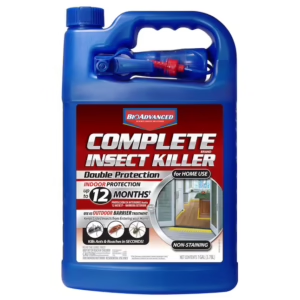
Active ingredient: cyfluthrin or beta-cyfluthrin (varies by SKU). Widely stocked at Home Depot. Effective residual (about 30 days on exterior perimeter) against palmetto bugs, spiders, ants, and silverfish.
Toxicity Rating:
Adults: 28/100 (Low)
Toddlers: 40/100 (Low)
Pets: 62/100 (High)
Cats cannot metabolize pyrethroids efficiently, so even small exposures matter – wet spray on paws ends up ingested during grooming. Cyfluthrin is classified “not likely to be carcinogenic,” and the dilute ready-to-use formula keeps adult and toddler exposure low. Cleanest of the four perimeter sprays.
#2. Ortho Home Defense Insect Killer
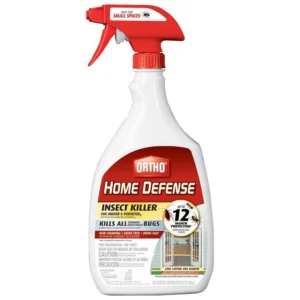
Active ingredient: bifenthrin (some SKUs) or zeta-cypermethrin. Widely stocked at Lowes. Similar effectiveness to Bayer/BioAdvanced. The “wand” applicator makes application easier than the pump models.
Toxicity Rating:
Adults: 35/100 (Low)
Toddlers: 48/100 (Moderate)
Pets: 65/100 (High)
Bifenthrin is an EPA Category C, possible human carcinogen – that flag is what lifts the toddler score above Bayer’s. Same feline pyrethroid sensitivity. The wand applicator actually helps: less hand contact than pump models.
#3. Spectracide Bug Stop
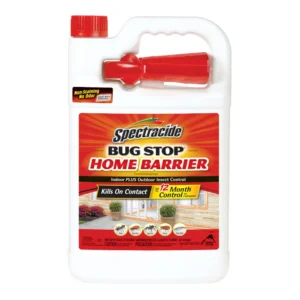
Active ingredient: gamma-cyhalothrin. Stocked at Home Depot. Lower price point than Bayer or Ortho. Shorter residual (2–3 weeks).
Toxicity Rating:
Adults: 42/100 (Moderate)
Toddlers: 50/100 (Moderate)
Pets: 68/100 (High)
The most acutely toxic spray active ingredient on this list (rat oral LD50 56-79 mg/kg). Applicators commonly report facial tingling and burning within 30 minutes, lasting from 6 hours to 2 days. Shorter residual also means more applications per season.
#4. Bifenthrin Granules (bulk)
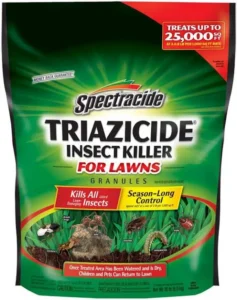
Not a brand — a category. Bulk bifenthrin granules from Home Depot broadcast around the exterior perimeter kill palmetto bugs, ants, and silverfish. Bags cost $20–$40 and cover thousands of square feet. Active ingredient is the same as what pros use. If you are the point of buying granules and taking the time to spread it, you are basically breaking even if you just hired a pest control company to treat the lawn.
Toxicity Rating:
Adults: 52/100 (Moderate)
Toddlers: 55/100 (Moderate)
Pets: 72/100 (High)
Highest adult score of any perimeter product here – you handle pounds of Category C material with airborne dust while broadcasting. Dogs eat granules straight off the ground, the largest ingestible quantity on this list. Gloves, dust mask, water in after application.
Gel Baits — Advion vs. Combat vs. Maxforce
#1. Advion Cockroach Gel Bait
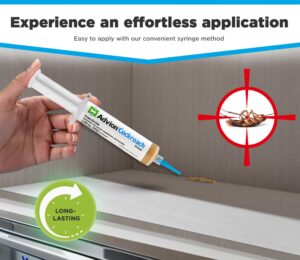
Active ingredient: indoxacarb. Available in consumer syringe format on Amazon. This is the professional-grade gel bait rebranded for consumers — the exact same chemistry pros use. Pea-sized dots in cabinet corners, behind fridge, under sinks.
Toxicity Rating:
Adults: 10/100 (Minimal)
Toddlers: 22/100 (Low)
Pets: 20/100 (Minimal)
The lowest scores on this entire list. EPA designates indoxacarb a “reduced-risk” pesticide, classifies it “not likely” carcinogenic, and found no increased susceptibility in infants and children. The best-performing roach product is also the safest one.
#2. Combat Roach Gel Bait

Active ingredient: fipronil. Home Depot and Lowes. Consumer standard. Effective but German roaches develop resistance to fipronil faster than to Advion’s indoxacarb — rotate between the two if you’re running a longer program.
Toxicity Rating:
Adults: 22/100 (Low)
Toddlers: 32/100 (Low)
Pets: 25/100 (Low)
Fipronil is an EPA Group C, possible human carcinogen, but it is only 0.05% of the gel applied in pinhead dots. Pets tolerate it well – fipronil is the same active ingredient used in topical flea treatments.
#3. Maxforce (various formulations)
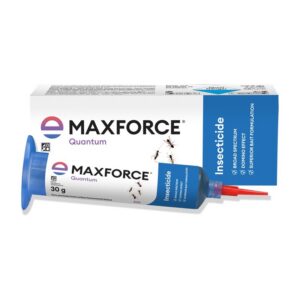
Also fipronil-based. Some pro-grade Maxforce SKUs are available on Amazon. Similar to Combat but pro-grade formulation.
Toxicity Rating:
Adults: 25/100 (Low)
Toddlers: 35/100 (Low)
Pets: 28/100 (Low)
Same chemistry as Combat at a higher, pro-grade concentration. Check the SKU: some Maxforce formulations use hydramethylnon rather than fipronil.
Bait Stations — Terro vs. Combat vs. Tomcat
#1. Terro Liquid Ant Bait
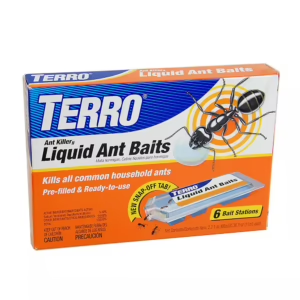
Active ingredient: borax (sodium tetraborate). Home Depot and Lowes. Sweet liquid bait workers carry back to the nest. Best for sugar-feeding ants (ghost ants, odorous house ants, sugar ants).
Toxicity Rating:
Adults: 12/100 (Minimal)
Toddlers: 45/100 (Moderate)
Pets: 35/100 (Low)
The biggest adult-to-toddler jump on this list. Borax has low acute toxicity, but this is sweet liquid in open trays at floor level, and boron carries documented developmental effects. Place trays behind appliances and under cabinets if you have a toddler or a floor-licking dog.
#2. Combat Roach + Ant Bait Stations
Solid-bait stations rather than gel. Less effective than Advion gel for roaches — but good for households with kids or pets that make gel bait risky.
Toxicity Rating:
Adults: 8/100 (Minimal)
Toddlers: 18/100 (Minimal)
Pets: 22/100 (Low)
The safest delivery format on the list. Fully enclosed and child-resistant, and a whole station weighs less than a penny. The realistic risk is a dog swallowing the plastic casing, not poisoning.
#3. Tomcat Rodent Bait Stations
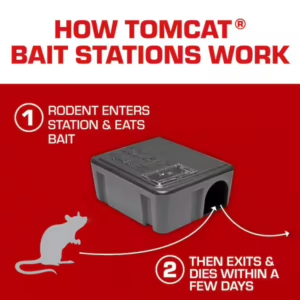
Home Depot. Locked bait stations for exterior perimeter placement. Do NOT use inside — rodents die in wall voids and you can’t retrieve them.
Toxicity Rating:
Adults: 45/100 (Moderate)
Toddlers: 70/100 (High)
Pets: 92/100 (Severe)
The most dangerous product here for pets, by a wide margin. Most current SKUs use bromethalin, which causes cerebral edema and has no antidote. Cats are exquisitely sensitive (LD50 0.4-0.71 mg/kg versus 2.38-5.6 in dogs), dogs chew stations open, and poisoned rodents carry secondary risk. Locked, staked, exterior only.
NEVER USE: Foggers (“Bug Bombs”) — Why Every Pro Says Not to Use Them
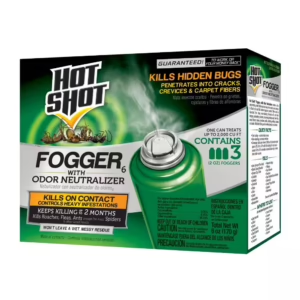
Every professional pest operator will tell you the same thing about foggers: don’t use them. The reasons are unanimous.
- Foggers push pests deeper into wall voids. German roaches scatter and re-establish in harborage sites you can’t reach.
- Broadcast application at homeowner rates isn’t accurate dosing. Under-dose = doesn’t kill. Over-dose = residue everywhere.
- Foggers hit surfaces that shouldn’t be hit — kitchen surfaces, kids’ toys, food-prep zones — because they can’t be aimed.
- Real risk to pets and people. Fogger recalls happen annually because a homeowner set one off with pilot light active and something ignited.
Toxicity Rating:
Adults: 85/100 (Severe)
Toddlers: 90/100 (Severe)
Pets: 88/100 (Severe)
The only product on this list that scores severe for every member of the household. The CDC documented 3,222 acute illness and injury cases across 10 states between 2007 and 2015, including four deaths. The leading cause was failure to vacate, and roughly 4% of cases were caused by a child under 13 setting one off.
Natural / Organic Products — What’s Legitimate
Diatomaceous earth (food-grade). Effective on crawling insects when kept dry — a physical rather than chemical mechanism. Legit for silverfish, roaches, and some ant species in dry, sheltered areas. Loses effectiveness when it gets damp.
Boric acid powder. Slower than gel baits but effective on roaches and silverfish. Available at every big-box store. Apply in wall voids and behind appliances.
Essential oils. Marketing hype. Peppermint, eucalyptus, tea tree — short-term irritation, no meaningful population reduction.
Vinegar and dish soap sprays. Kills insects on direct contact. Zero residual effect. Fine for one-off spot treatment; useless for infestations.
The Right Product for the Wrong Problem — Common Homeowner Mistakes
- Spraying the perimeter for German cockroaches. German roaches live indoors — perimeter spray doesn’t reach them.
- Using gel bait for palmetto bugs. Palmetto bugs live outdoors and only briefly come inside — perimeter treatment is what stops them.
- Buying Tomcat bait for indoor rodents. Rodents die in wall voids — use snap traps for interior.
- Applying Ortho monthly. Over-application breeds resistance in the exact colony you’re trying to kill.
Tried DIY and still seeing pests? Book a free inspection.
Free property walkthrough across St. Johns and Flagler Counties. Brandon does the inspection himself, identifies what you actually have, and gives you a written quote before any work happens. Figuring out the right bait and pesticide to use is not always straight forward. If you have tried a few DIY options and now are looking for professional pest control services, give us a call or fill out a contact form.
Frequently Asked Questions
Is Advion gel from Amazon the same as what pros use?
Effectively yes — the consumer Advion has the same active ingredient concentration as the pro version. The bigger difference in professional treatment is chemistry rotation and knowing where roaches actually harbor.
Do I need to rotate ant baits?
For long-running problems, yes. Ants develop food-source fatigue on repeat baits. Rotate between sweet (Terro liquid) and protein-based baits every few weeks. Most ant colonies prefer one bait over the other so the key is test both baits first and see what they like more.
Are foggers ever the right answer?
No. Not for anything. Every operator you’ll talk to will tell you the same.
How do I know if I need to escalate to a pro?
Two weeks with the right product for the right pest is a fair test. If you’re not seeing significant improvement by then, escalate. Waiting longer just lets the population grow and breeds product resistance. Most pest control services are able to use products that are not on the shelf, dramatically increasing their effectiveness.
Sources
Toxicity scores are based on published EPA, NPIC, CDC, and veterinary toxicology data. Sources below, grouped by what they support.
Active ingredient toxicity (LD50, EPA category, cancer classification)
- Bifenthrin — National Pesticide Information Center, Bifenthrin Technical Fact Sheet
- Fipronil — National Pesticide Information Center, Fipronil Technical Fact Sheet
- Cyfluthrin — National Pesticide Information Center, Cyfluthrin Fact Sheet
- Cyhalothrin — National Pesticide Information Center, Lambda-cyhalothrin Technical Fact Sheet (closest published data for the gamma isomer used in Spectracide)
- Boric acid and borates — National Pesticide Information Center, Boric Acid Technical Fact Sheet
- Indoxacarb — U.S. Environmental Protection Agency, Pesticide Fact Sheet for Indoxacarb
Rodenticides and bromethalin
- U.S. Environmental Protection Agency, Recognition and Management of Pesticide Poisonings, Chapter 18: Rodenticides
- Merck Veterinary Manual, Bromethalin Poisoning in Animals
Foggers and total release aerosols
- Centers for Disease Control and Prevention, Acute Illnesses and Injuries Related to Total Release Foggers — 10 States, 2007–2015 (MMWR)
Pet toxicity
- VCA Animal Hospitals, Pyrethrin and Pyrethroid Poisoning in Cats
- VCA Animal Hospitals, Essential Oil and Liquid Potpourri Poisoning in Cats
- Today’s Veterinary Nurse, Top 10 Toxins That Are Rarely Serious
Brandon Micalizzi is the licensed owner-operator of Unity Pest & Wildlife, based in St. Augustine, FL. He’s been serving St. Johns and Flagler Counties since 2023 as an owner-operator, with nearly a decade in the industry (since 2017). If you need help with persistent pest activity, book a free inspection or call (386) 597-3955.
