After a Decade in Pest Control, Here Are the Best Ways to Do Lawn & Palm Care in St. Augustine, Palm Coast & St. Johns
A homeowner in World Golf Village called me about his palms last May. Four mature sabal palms in the front yard, all yellowing from the top down. His HOA landscaper had been fertilizing them for two years with “the standard 16-4-8 lawn blend” and telling him not to worry. By the time I got out there, one of the four had a spear frond so weak I could pull it out with two fingers. That palm was gone. The other three still had a fighting chance — but only if we treated them within the next 30 days.
He asked me the same question I get almost every week: “Why does everything I know about lawn care from up north not work down here?”
The short answer: Florida’s sandy soil doesn’t hold nutrients the way the loam soils of the northeast and midwest do. The fertilizers that work perfectly in Ohio or New Jersey wash straight through our sand in a single afternoon rain. And the palms that make North Florida landscapes so beautiful require nutrients that no general-purpose lawn fertilizer supplies. This is the guide I use to walk homeowners through what actually works here.

Why Lawns and Palms Are So Tricky in the St. Johns and Flagler Corridor
The Sandy Coastal Soil Problem
The soil profile across most of St. Johns and Flagler Counties is fine white sand with almost no organic matter in the top six inches. Sand has terrible cation exchange capacity — meaning it doesn’t hold onto positively charged nutrients like potassium, calcium, and magnesium. Rain leaches them out. That’s why the palm nutrient deficiencies you’ll read about below are so common here and so rare in states with heavier soils.
Sub-Tropical Humidity and Fungal Disease
The coastal humidity that makes summers unpleasant for us is a paradise for turf fungi. Brown patch, gray leaf spot, and take-all root rot are the three most common we see. All three exploit stressed grass — which means the way you fertilize and water matters as much as whether you spray fungicide.
Why Northern Fertilizers Fail Here
The classic 16-4-8 or 20-5-10 blends common in the northeast are heavy on nitrogen and light on potassium. That ratio works fine in stable soils. In our sand, it just burns the top growth green while starving the root system of the potassium it needs to hold on to water and resist disease. The result is grass that looks great in April and dies of fungus in July.
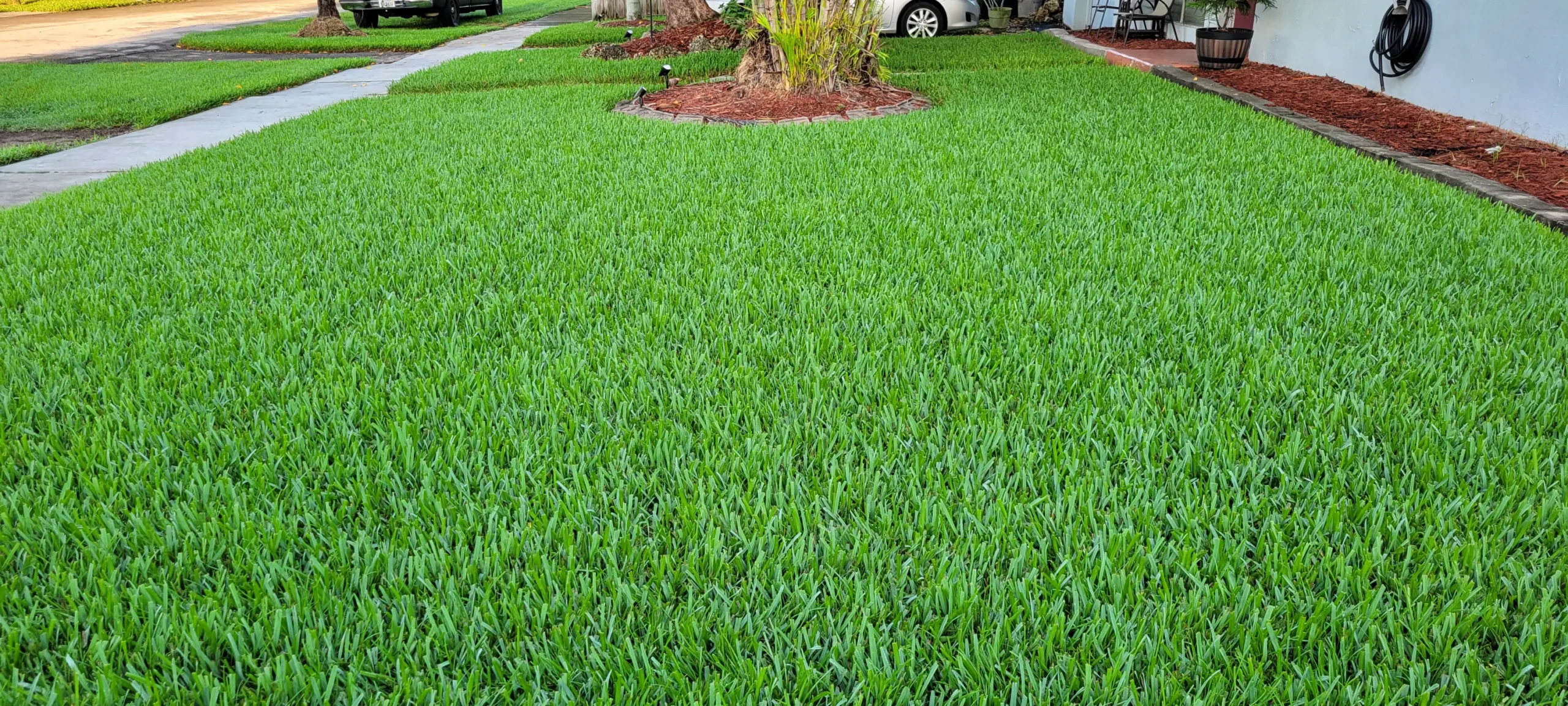
St. Augustine Grass — The Dominant North Florida Turf
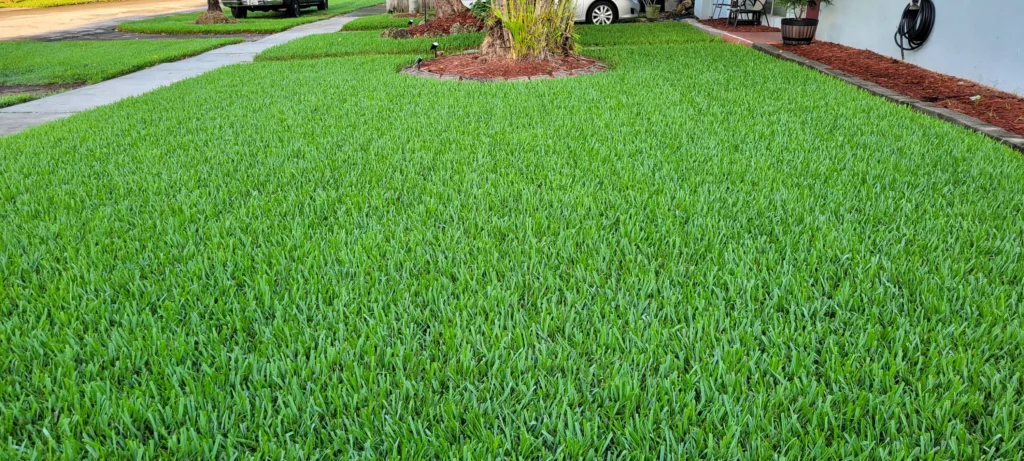
Ninety percent of lawns in St. Johns and Flagler are St. Augustine grass. It’s the right choice for our climate. Dense, dark green, tolerant of humidity and light shade, and thick enough to choke out most weeds without an overseed program. But it has specific requirements that most homeowners don’t get right.
Mow High — 3.5 to 4 Inches
The single most common mistake I see is homeowners mowing St. Augustine at 2.5 inches like it’s a golf-course turf. It’s not. St. Augustine wants to be tall. Mowed at 3.5–4 inches, it shades out weeds, develops deeper roots, and resists chinch bug damage. Mowed at 2.5, it’s stressed, weedy, and chinch-prone.
Water Deep, Not Frequent
One inch of water per week is enough. Ideally delivered in one long soak — 45 minutes to an hour per zone on most systems — rather than 15 minutes every other day. Deep watering pushes roots down. Frequent shallow watering keeps roots at the surface where they die during the July heat.
Fertilize With Slow-Release, Palm-Blend Nitrogen
The right fertilizer for St. Augustine in North Florida is an 8-2-12 blend with slow-release nitrogen and micronutrients. That ratio has more potassium than nitrogen — the opposite of a northern lawn blend — and it’s the ratio that matches what our sandy soil actually loses.
Watch for Chinch Bugs
Chinch bugs are the number-one killer of St. Augustine grass in North Florida. They feed at the base of the grass blades and inject a toxin that kills the plant. Damage typically shows up in July and August as expanding irregular brown patches — often mistaken for drought stress. Preventive treatment in May prevents the damage that starts in July. It’s the single most valuable thing on an annual lawn calendar.
The Nutrient Deficiencies Killing Your Palms
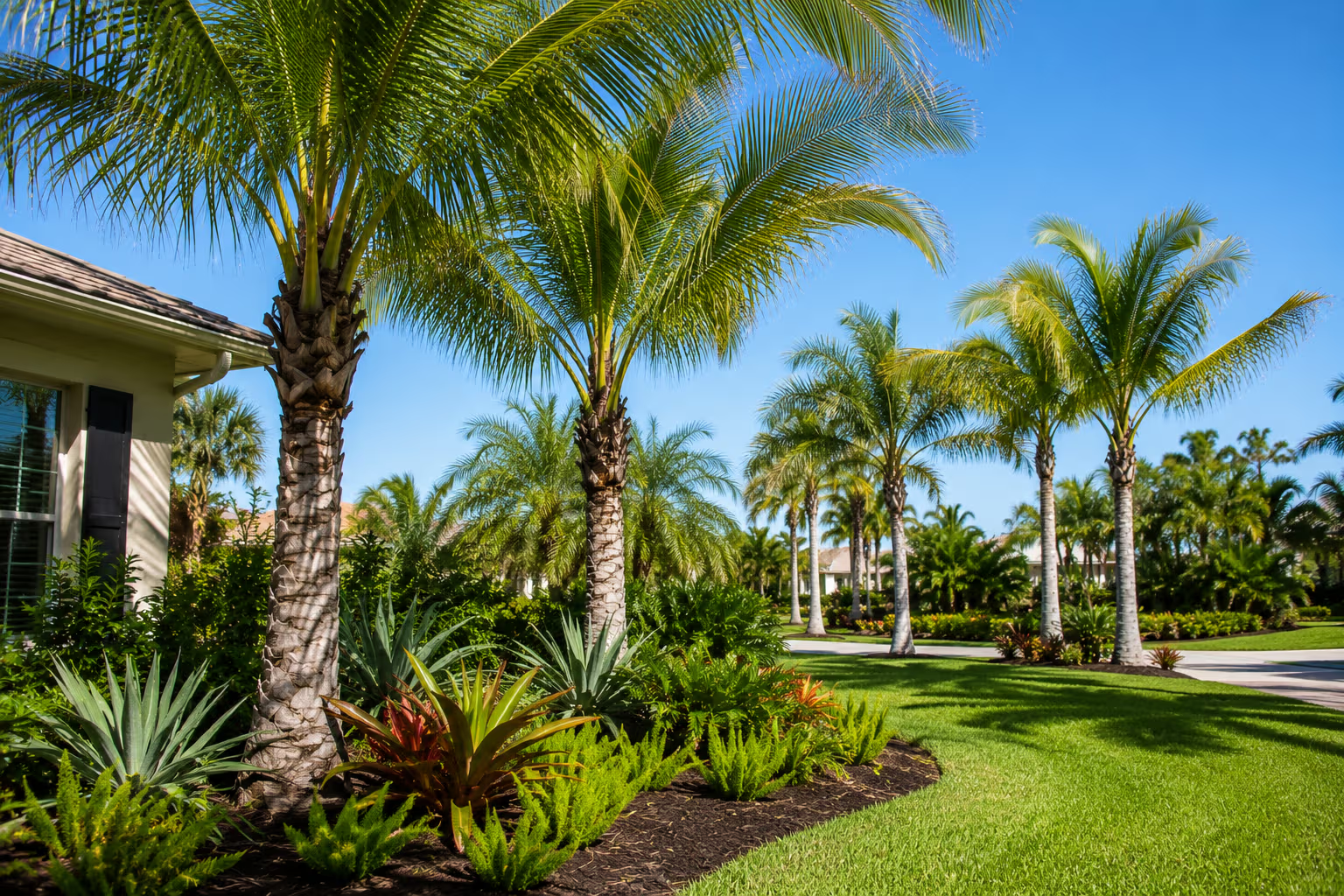
Manganese Deficiency (“Frizzle Top”) — The Fatal Deficiency
Manganese deficiency is the most dangerous palm nutrient deficiency because it kills palms. New fronds emerge weak, frizzled, and yellow. The growing tip — called the spear or “bud” — looks stunted or crumpled. Untreated, the palm cannot produce new fronds and dies from the top down.
Common in sabal (cabbage), queen, coconut, and date palms. The fix is manganese sulfate applied as both a soil drench and a foliar spray, two to three rounds during the growing season. Prevention comes from using a proper palm-specific fertilizer that includes manganese as a micronutrient.
The client I opened this guide with had textbook frizzle top. Three palms recovered fully within eight months of correct treatment. The fourth was too far gone — its bud had already died.
Potassium Deficiency
Potassium is the most common palm deficiency in North Florida. Older fronds yellow starting at the tip and progress inward. As the deficiency progresses, the tips die back and the entire older frond eventually browns and drops. The reason: palms mobilize potassium from old fronds to new growth when there’s not enough — that yellowing is the plant sacrificing older leaves to keep new ones alive.
Very common in the coconut and sabal palms most planted in Palm Coast and St. Augustine. Fix is slow-release potassium sulfate applied three times per year, plus correcting the ongoing fertilizer program to an 8-2-12 palm blend.
Magnesium Deficiency
Yellow bands along the edges of older fronds, with the center of each frond staying green. Called chlorosis. Older, taller palms show it first because they’ve been depleting soil magnesium longer. Common in sabal palms and date palms.
Fix is magnesium sulfate soil application, two rounds per year. Best combined with the potassium program since the two deficiencies almost always co-occur — treating one without the other doesn’t fully solve the problem.
Boron Deficiency
New fronds emerge truncated, deformed, or “crumpled” — often confused with frizzle top because the visual is similar. Less common than the other three but destructive when it happens.
Common in sandy Palm Coast lots with heavy rain leaching and in newly-installed palms planted into poor soil. Fix is a foliar boron spray, applied carefully — over-application is toxic to the palm, which is why this is a licensed-operator-only treatment.
The Annual Calendar — What Should Happen and When
Winter (Jan – Feb) — Pre-Emergent
Pre-emergent weed control before spring germination. This one application prevents the majority of the weed pressure you’d otherwise fight all summer. Winter fertilizer boost for palms to prep them for the growing season.
Spring (Mar – May) — Green-Up + Chinch Bug Prep
Post-emergent for broadleaf weeds that snuck past the pre-emergent. Slow-release nitrogen. First palm feeding of the year. Preventive chinch bug treatment in May — before the July surge — is the single most valuable spring visit.
Summer (Jun – Aug) — Fungal Prevention + Peak-Season Insects
Pre-brown-patch fungicide before the humidity peaks. Mid-season palm micronutrient round. Sod webworm monitoring — moths at dusk mean webworms in the lawn. Second chinch bug application at peak humidity.
Fall (Sep – Nov) — Root-Feed + Pre-Winter Cleanup
Recovery fertilizer for stressed turf. Final palm micronutrient round of the year. Late-season broadleaf weed control. Dormancy-timing adjustments.
The reality of one-off service: a single application in June won’t fix a lawn that’s been mismanaged for two years. Lawn recovery in Florida is a 12-to-18-month project. That’s why almost all of our lawn clients are on the annual program — it’s the only way results stick.
What This Costs
Standard lawn program (annual cycle — fertilization, weed control, pest treatment for typical lots under 8,000 sq ft): starting at $65 per visit.
Lawn + Palm program (everything above plus dedicated palm nutrient program with 3 rounds per year — best for homes with 3+ palms): $85–$140 per visit.
Palm-only treatment (just the palms, 3 rounds per year — great for HOA-managed lawns): $180–$450 per treatment, priced by palm count and size.
Palms yellowing? Lawn thinning? Time for a free assessment.
Free property walkthrough across St. Johns and Flagler Counties. Brandon diagnoses the deficiency, ID’s the pest, and quotes a treatment calendar. No obligation. If your palms are yellowing or losing fronds, don’t wait — the sooner we intervene, the better the outcome.
See Lawn & Palm Care Services →Frequently Asked Questions
Why are my palm fronds turning yellow?
Nine times out of ten it’s a nutrient deficiency — potassium, manganese, magnesium, or boron. North Florida’s sandy soil doesn’t hold micronutrients, and generic lawn fertilizer makes it worse. Correct diagnosis matters because the treatment is different for each deficiency.
When should I fertilize St. Augustine grass in North Florida?
The proper calendar is winter pre-emergent, spring green-up (March–May), summer maintenance (June–August with chinch bug and fungus prevention), and fall root-feed (September–November). Never fertilize during a hard summer heat wave — you’ll burn the lawn.
How do I know if I have chinch bugs?
Chinch bug damage looks like irregular expanding brown patches in the sunniest part of the lawn, usually in July or August. Confirm by parting the grass at the edge of a brown patch and looking for small black-and-white insects. Preventive treatment in May prevents the damage entirely.
Can I fertilize palms with regular lawn fertilizer?
No. Palms need a specific 8-2-12 palm blend with micronutrients (manganese, magnesium, potassium, boron). Regular lawn fertilizer is too high in nitrogen and low in the micronutrients palms actually need, and using it causes the deficiencies you see across North Florida landscapes.
Do you treat HOA properties?
Yes. Many of our accounts are HOA-managed lawns where the HOA handles turf and we handle palms only. Palm-only programs price by palm count and size, with three treatments per year on a consistent schedule.
How long does it take to see results?
Chinch bug treatment: results in 7–10 days. Palm nutrient recovery: 60–90 days to see improvement in new fronds; 6–12 months for full recovery of a badly deficient palm. Lawn recovery from mismanagement: 12–18 months on the annual program.
Brandon Micalizzi is the licensed owner-operator of Unity Pest & Wildlife, based in St. Augustine, FL. He’s been serving St. Johns and Flagler Counties since 2023 as an owner-operator, with nearly a decade in the pest and lawn care industry (since 2017). If your lawn or palms need attention, book a free property walkthrough or call (386) 597-3955.
